so-AIRMES
/ 11 min read / #mobile #reverse #react-native #hermes
- Event
- Insomni'hack 2026
- Difficulty
- medium
- Points
- -
I first published this writeup on the OteriHack blog, my CTF team's site. This is the same article.
Insomni'hack 2026 - Orange Cyberdefense Switzerland - Mobile / Reverse Engineering
soairmes-19d57e84105a9ea0fa7da0646b2b47f853cb4ba366026d88c7c13dee0de6dbb5.apk
Anthony Bondu (Fawlen) - Oterihack - Symbiotic Security
Initial Recon
We are given an APK file. Unfortunately, I couldn't do any dynamic analysis during the CTF because the internet connection was too slow to download the Android tools needed (Android SDK, emulator, etc.). So this was done entirely through static analysis.
The first reflex for any Android reverse challenge is to open it in JADX.
AndroidManifest.xml
The first thing we check is the AndroidManifest.xml because it's the quickest way to find the application's entry point.
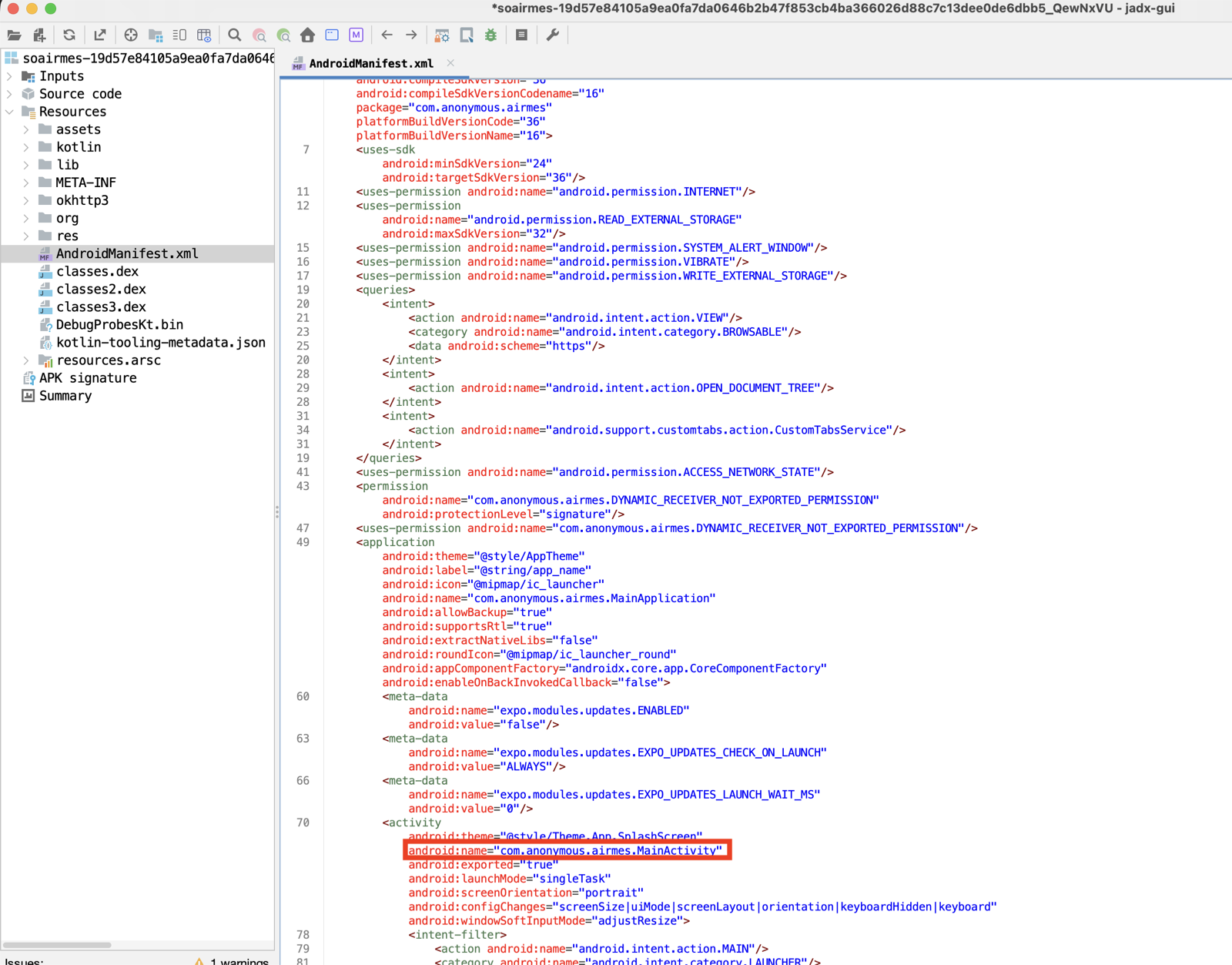
We can read the package name (com.anonymous.airmes) and, scrolling down to the <activity> tag with the MAIN/LAUNCHER intent filter, we find the main activity: com.anonymous.airmes.MainActivity.
Main Activity
Clicking on com.anonymous.airmes.MainActivity in JADX, we immediately see it extends ReactActivity:
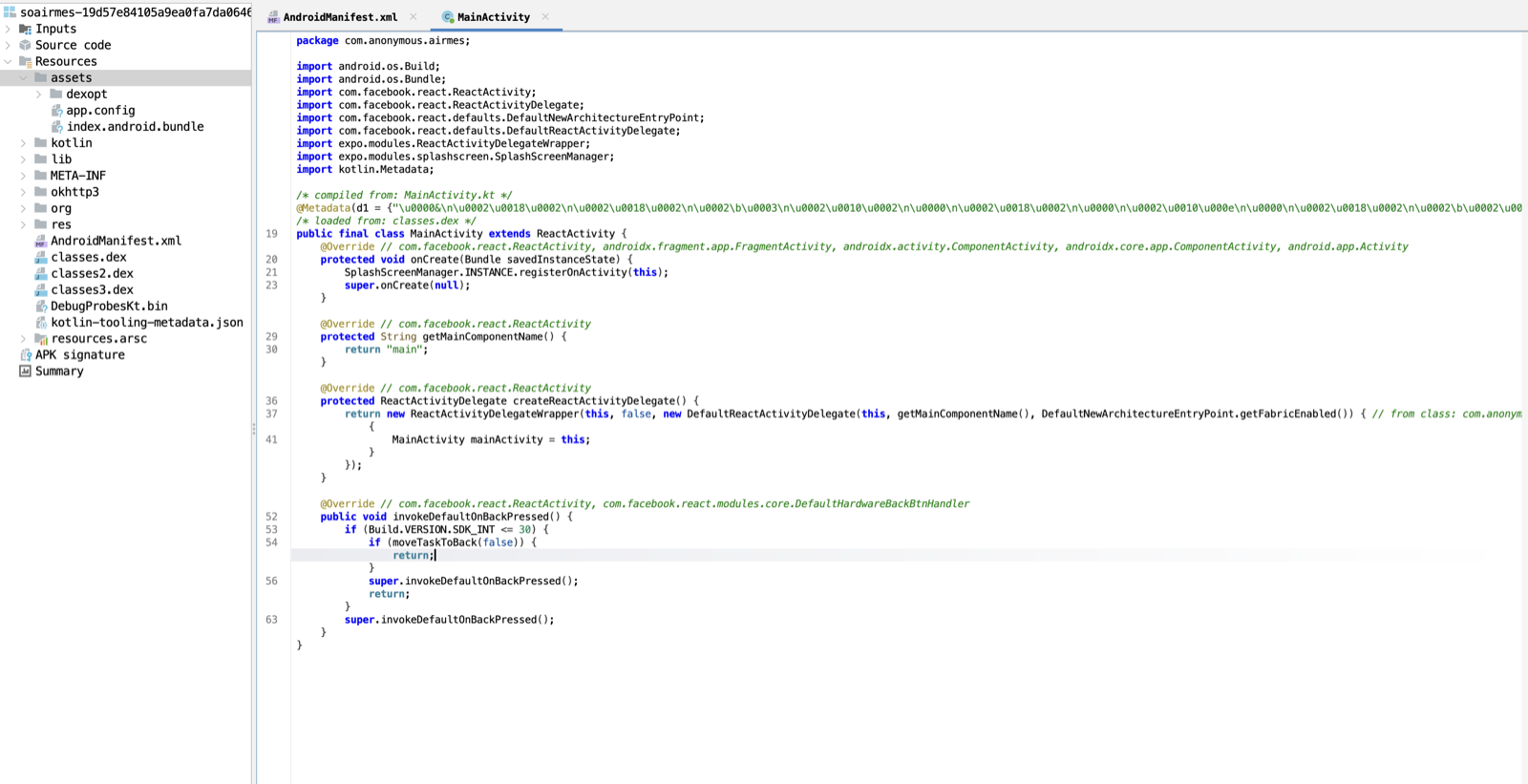
This confirms we're dealing with a React Native application. The Java/Kotlin layer is just a thin shell and the real application logic lives in JavaScript, bundled inside the APK.
Exploring the Assets
Since it's React Native, we navigate to assets/ in the APK and find index.android.bundle. This is not plain JavaScript, it's compiled Hermes bytecode. Hermes is Meta's JavaScript engine for React Native that precompiles JS into bytecode for faster startup. Opening it in a text editor shows binary data, not readable JS.
At this point, we extract the full APK to work with the files directly:
soairmes.apk
  assets/
    index.android.bundle        <- Hermes bytecode (compiled JS)
  lib/
    arm64-v8a/
      libairmesnative.so      <- Native C++ module
    armeabi-v7a/
      libairmesnative.so
    x86/
      libairmesnative.so
    x86_64/
      libairmesnative.so
  classes.dex
  AndroidManifest.xml
We note the presence of libairmesnative.so compiled for four architectures, but we don't know its role yet. Let's first analyze the Hermes bytecode to understand the application flow. The native library will come into play later.
Hermes Bytecode Analysis with hermes-decomp
Since the JavaScript is compiled to Hermes bytecode, we need a specialized tool to analyze it. Standard JS deobfuscators won't work here. We use hermes-decomp by Symbiotic Security, a Rust-based decompiler for Hermes bytecode that can disassemble, decompile, and perform cross-reference analysis on .hbc files. This challenge actually served as one of the real-world test cases for the tool.
hermes-decomp is open-source and available on GitHub: github.com/SymbioticSec/hermes-decomp. It supports disassembly, full decompilation, Metro module extraction, string dumping, and cross-reference analysis for Hermes bytecode files. If you're doing React Native reverse engineering, this is the tool you want.
Bundle Overview
$ hermes-decomp info index.android.bundle
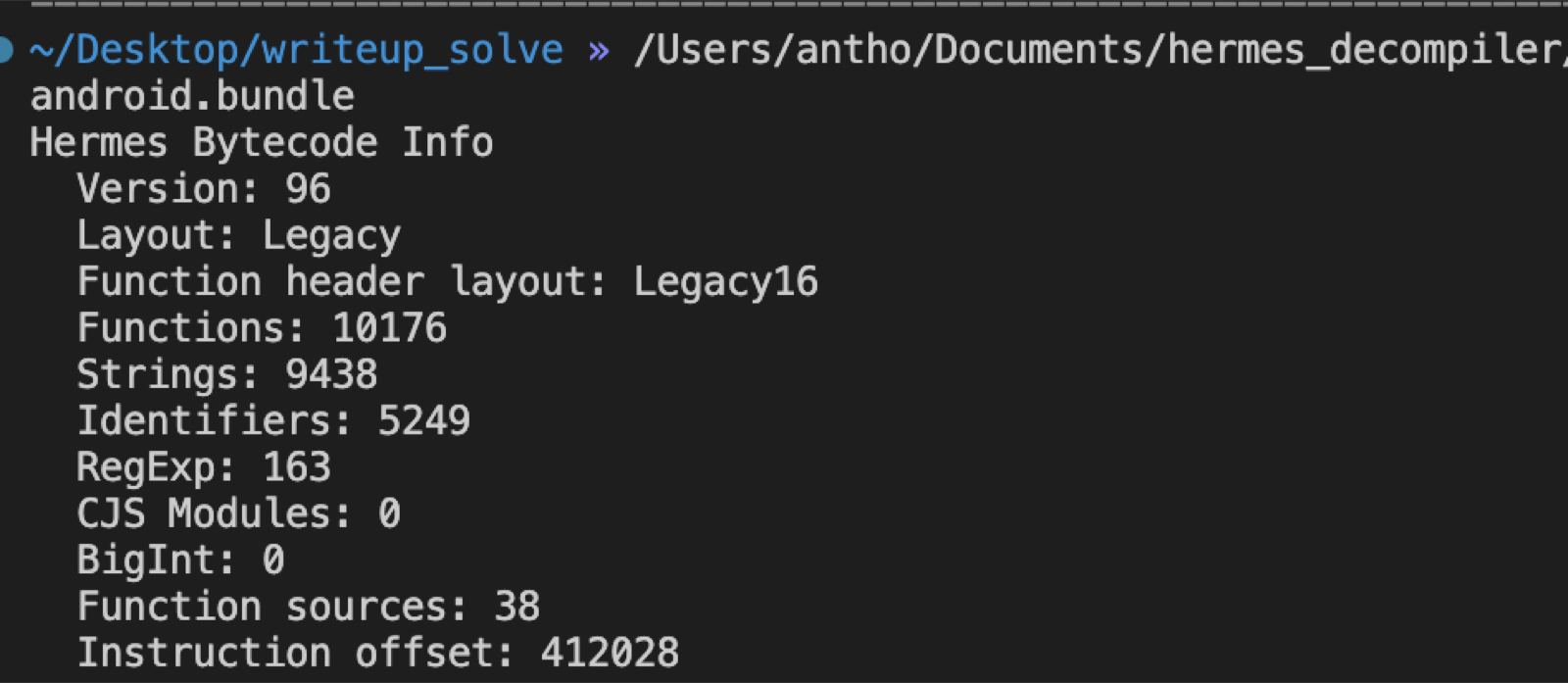
10,176 functions, 9,438 strings. That's a full React Native app with all its dependencies bundled in. We need a strategy to find the challenge logic in this haystack.
Full Decompilation First
Rather than guessing which function to look at, we start by decompiling everything and extracting all Metro modules to get an overview of the application structure:
$ hermes-decomp decompile index.android.bundle --output full_decompile.js
$ hermes-decomp extract index.android.bundle --output modules/
$ hermes-decomp dump --kind strings index.android.bundle > strings_dump.txt
This gives us 956 extracted Metro modules and a full string table. Searching through the strings immediately reveals the interesting ones:
[342]  "so-AIRMES"
[941]  "REVEAL FLAG"
[2692] "Native module missing: AirmesCrypto.reveal()"
[4528] "insomnihack 2026 - Orange Cyberdefense Switzerland"
[6011] "AirmesCrypto"
Now we use xref to trace where these strings are referenced:
$ hermes-decomp xref index.android.bundle --query "AirmesCrypto"
  Function 10138 () at offset 00d0: GetById       <- module import
  Function 10143 (?anon_0_) at offset 0057: LoadConstString  <- error message

This tells us exactly where to look: Function 10138 is the module that imports AirmesCrypto, and Function 10143 uses it. Now we can dive into these specific functions.
Understanding the Application Flow
The Main Module (F10138)
$ hermes-decomp decompile index.android.bundle --function 10138
hermes-decomp produces the following decompiled output (truncated for brevity):
// Function 10138 - Decompiled
function f10138(arg0, arg1, arg2, arg3, arg4, arg5, arg6, arg7) {
  closure_0 = arg1;
  closure_1 = arg6;
  fn = /* F10139 */ function _interopDefault() { ... };
  closure_9 = /* F10140 */ function Index() { ... };
  closure_10 = /* F10146 */ function statusDotStyle() { ... };
  // ...
  closure_7 = tmp2.NativeModules.AirmesCrypto;
  StyleSheet = tmp2.StyleSheet;
  obj2 = { root: { flex: 1, backgroundColor: "#050505", ... }, ... };
  closure_8 = StyleSheet.create(obj2);
}
This is the Metro module (module 950) that initializes the challenge. The key line is closure_7 = tmp2.NativeModules.AirmesCrypto, which stores a reference to the native module. We can also see it registers a React component Index (F10140) and a statusDotStyle helper.
The UI Component: Index (F10140)
$ hermes-decomp decompile index.android.bundle --function 10140
// Function 10140 - Decompiled
function Index(arg0) {
  tmp13 = undefined;
  defaultResult = closure_3.default(closure_4.useState("READY"), 2);
  tmp2 = defaultResult[0];
  closure_0 = defaultResult[1];
  defaultResult1 = closure_3.default(closure_4.useState(""), 2);
  [r10020, closure_1] = defaultResult1;
  // ...
  obj = { style: closure_8.title, children: "so-AIRMES" };
  items[1] = closure_6.jsx(closure_5.Text, obj);
  obj3 = { style: closure_8.subtitle, children: "Challenge" };
  items[2] = closure_6.jsx(closure_5.Text, obj3);
  // ...
  obj6 = { style: closure_8.buttonText, children: "REVEAL FLAG" };
  items[4] = closure_6.jsx(closure_5.Pressable, obj5);
  // ...
  obj10.children = "insomnihack 2026 - Orange Cyberdefense Switzerland";
}
The decompiled output clearly shows a React component. We can read the UI structure directly: a title "so-AIRMES", a "REVEAL FLAG" button wired to onPressReveal(), and status indicators. Following the closure chain, the button handler is created in F10141, which wraps an async generator F10142/F10143.
The Reveal Handler (F10143): The Core Logic
$ hermes-decomp decompile index.android.bundle --function 10143
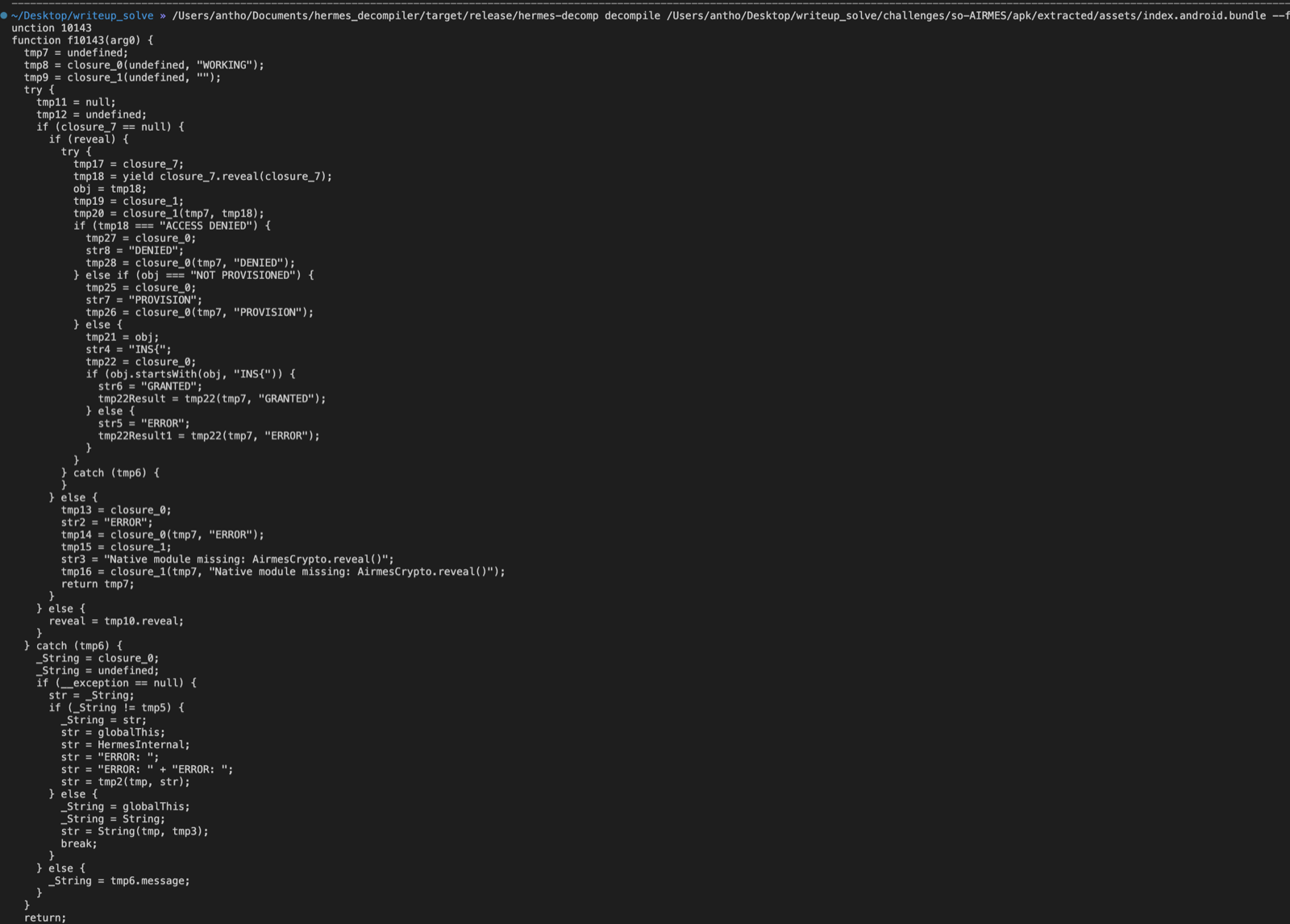
F10143 is a generator function (async/await). hermes-decomp handles the generator state machine and produces the following decompiled output:
function f10143(arg0) {
  tmp7 = undefined;
  tmp8 = closure_0(undefined, "WORKING");
  tmp9 = closure_1(undefined, "");
  try {
    tmp11 = null;
    tmp12 = undefined;
    if (closure_7 == null) {
      if (reveal) {
        try {
          tmp17 = closure_7;
          tmp18 = yield closure_7.reveal(closure_7);
          obj = tmp18;
          tmp19 = closure_1;
          tmp20 = closure_1(tmp7, tmp18);
          if (tmp18 === "ACCESS DENIED") {
            tmp28 = closure_0(tmp7, "DENIED");
          } else if (obj === "NOT PROVISIONED") {
            tmp26 = closure_0(tmp7, "PROVISION");
          } else {
            if (obj.startsWith(obj, "INS{")) {
              tmp22Result = closure_0(tmp7, "GRANTED");
            } else {
              tmp22Result1 = closure_0(tmp7, "ERROR");
            }
          }
        } catch (tmp6) { }
      } else {
        closure_0(tmp7, "ERROR");
        closure_1(tmp7, "Native module missing: AirmesCrypto.reveal()");
        return tmp7;
      }
    } else {
      reveal = tmp10.reveal;
    }
  } catch (tmp6) { ... }
  return;
}
The decompiled output is very readable. We can directly follow the logic:
closure_0("WORKING")sets status to WORKINGclosure_1("")clears the output- Check if
closure_7(which isAirmesCrypto) exists and has arevealmethod result = yield closure_7.reveal()calls the native method (yield = await in generator context)- If result starts with
"INS{"-> status"GRANTED", this is the flag - Otherwise:
"ACCESS DENIED"->"DENIED","NOT PROVISIONED"->"PROVISION", else ->"ERROR"
This tells us everything we need to know on the JS side:
- The flag comes from
AirmesCrypto.reveal(), a native JNI call - The flag format is
INS{...}(confirmed by thestartsWithcheck) - The JS layer is just UI, all the real crypto happens in native code
Back to JADX: Finding the Native Bridge
Now that we know the JavaScript calls NativeModules.AirmesCrypto.reveal(), we go back to JADX and search for AirmesCrypto. We find com.anonymous.airmes.crypto.AirmesCryptoModule, a Kotlin class that:
- Loads the native library with
System.loadLibrary("airmesnative") - Declares an
external fun nativeReveal(): String, the JNI bridge - Exposes
reveal()to JavaScript, which simply callsnativeReveal()
So this is where libairmesnative.so comes in. The Kotlin layer is a thin pass-through: when JS calls AirmesCrypto.reveal(), it goes straight to native C++ code via JNI.
Reversing the Native Library in IDA
Now we switch to IDA to reverse engineer libairmesnative.so. We use the x86_64 version for cleaner pseudocode output.
Identifying Entry Points
The function list in IDA immediately shows two named symbols: airmes_read_token and Java_com_anonymous_airmes_crypto_AirmesCryptoModule_nativeReveal. The rest are unnamed sub_XXXX.
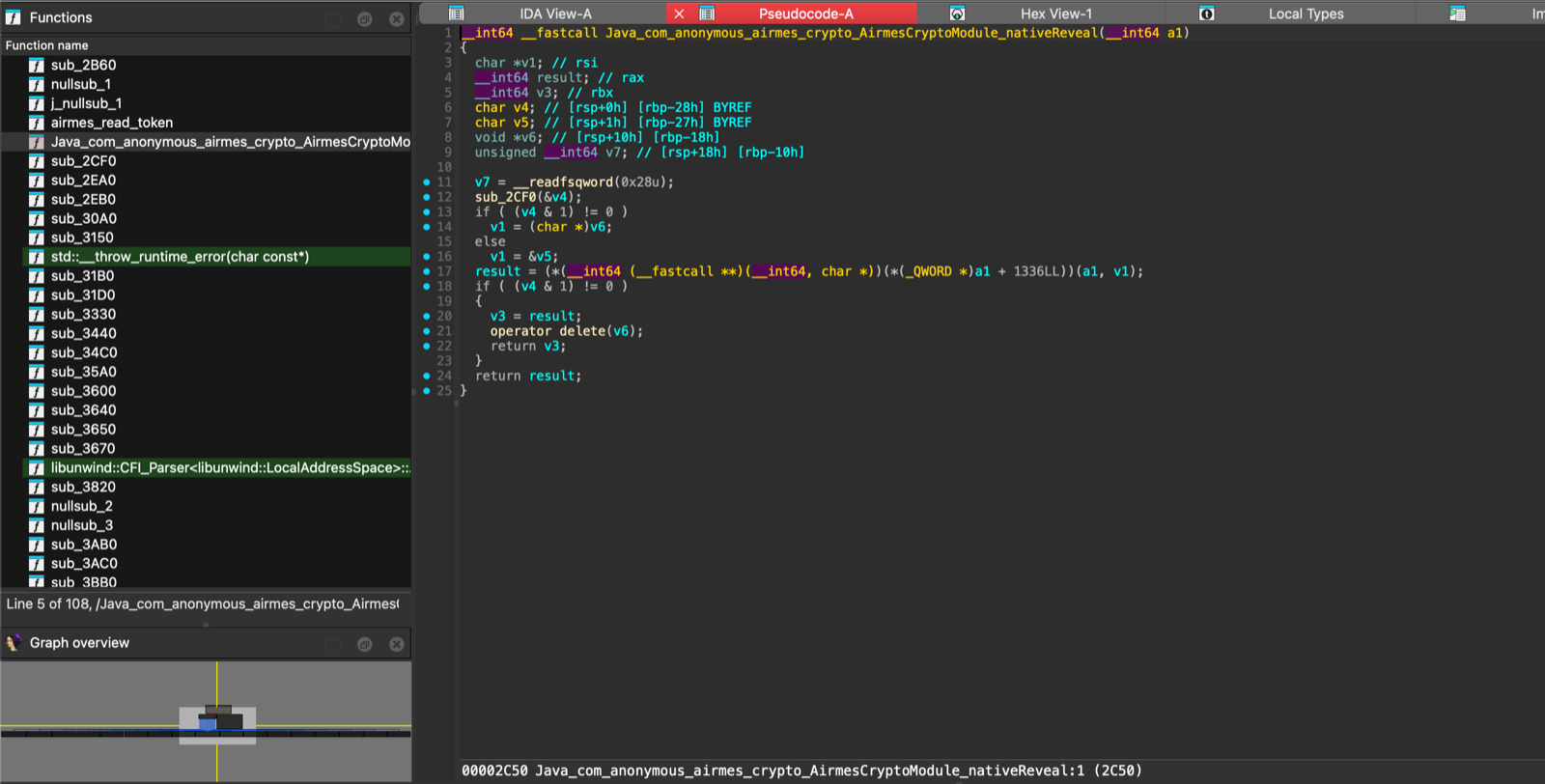
Architecture
Java_...nativeReveal (0x2C50)
    sub_2CF0 (internal wrapper)
        airmes_read_token()     reads 8 bytes from provision.dat
        sub_2EA0()              validates magic bytes (bswap check)
        sub_2EB0()              djb2 hash + xorshift32 PRNG
        sub_31D0()              key derivation (ROL4 mixing)
        sub_30A0()              XOR keystream with constants -> flag
airmes_read_token
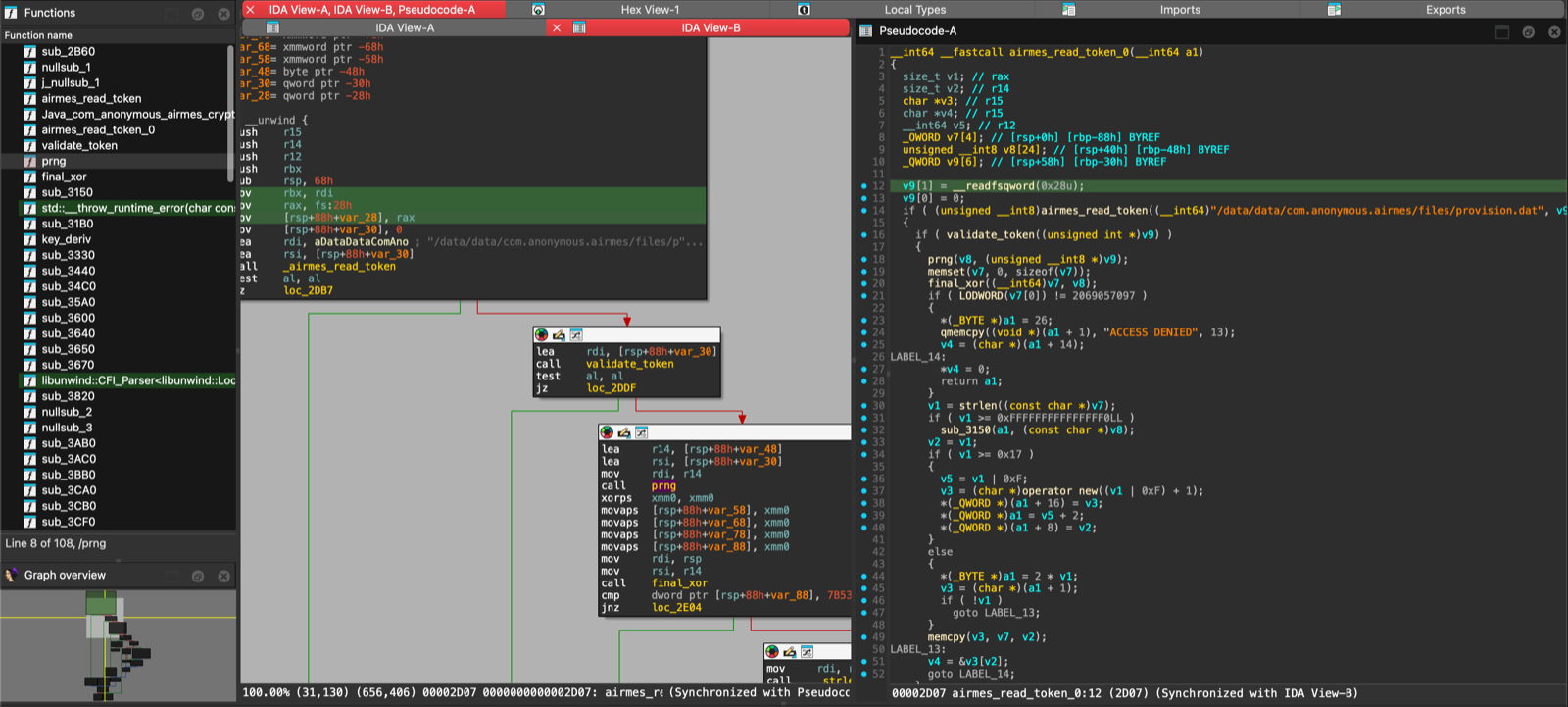
This function opens /data/data/com.anonymous.airmes/files/provision.dat, reads exactly 8 bytes into a buffer, and returns a boolean indicating success. If the file doesn't exist or has fewer than 8 bytes, it returns false, and nativeReveal returns "NOT PROVISIONED".
sub_2EA0: Token Validation
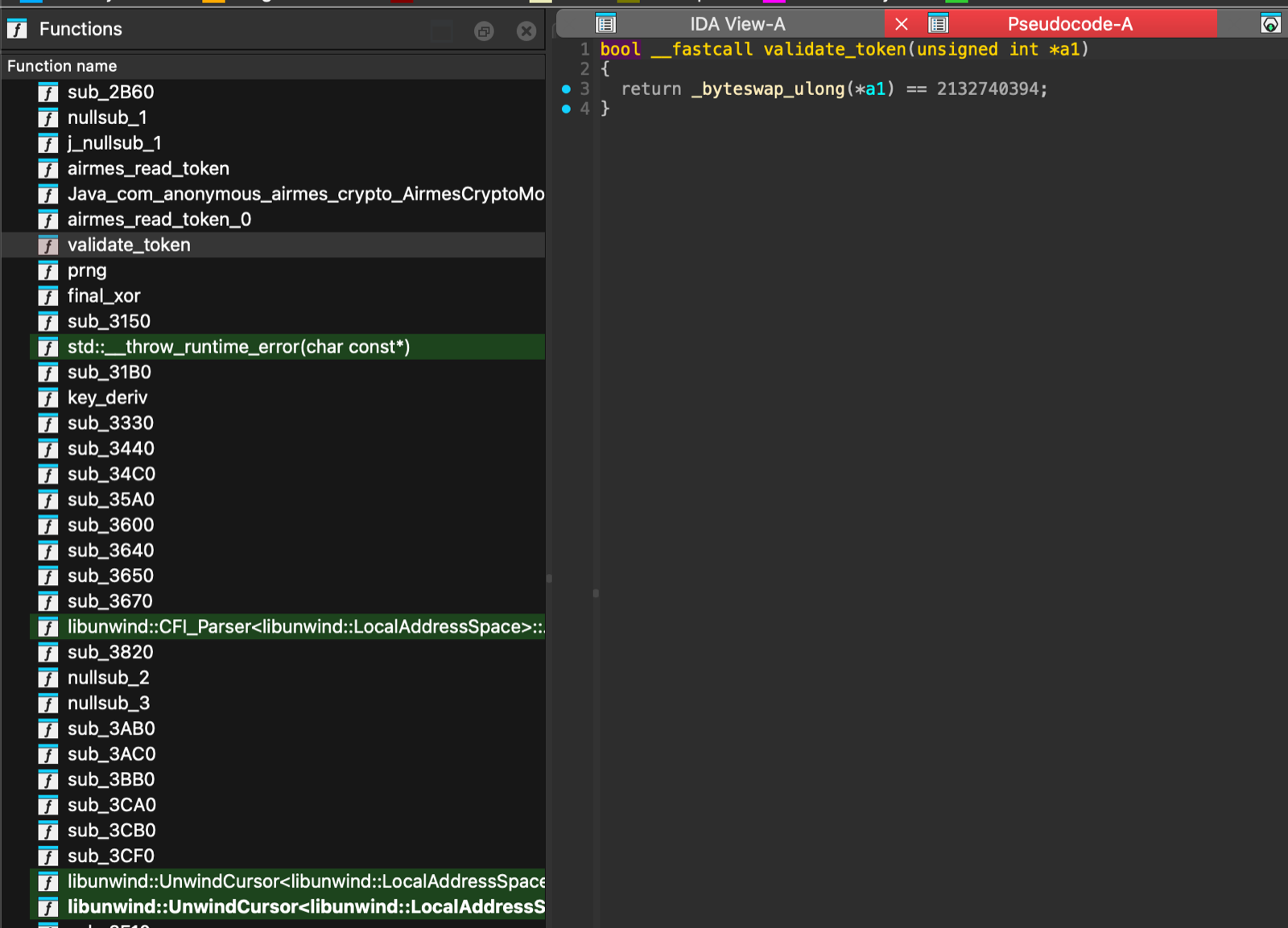
IDA decompiles this to one line:
bool __fastcall sub_2EA0(unsigned int *a1)
{
    return _byteswap_ulong(*a1) == 2132740394;
}
2132740394 in hex is 0x7F1F092A. So the first 4 bytes of the token must be 0x2A, 0x09, 0x1F, 0x7F (little-endian). If validation fails, nativeReveal returns "ACCESS DENIED".
sub_31D0: Key Derivation
IDA shows a massive nested expression of __ROL4__ (rotate left 32-bit) operations. The constant 1640531527 is the unsigned representation of -0x9E3779B9 (the golden ratio constant, commonly used in hash functions like TEA/XTEA).
The function takes 16 PRNG bytes and mixes them through:
- Processing bytes in groups of 4 with variable shifts (
<< 8,<< 16,<< 24) - Subtracting
0x9E3779B9at each round - Nested
ROL4with rotation count of 5
The result is a single 32-bit seed that feeds into a final xorshift32 to produce 29 bytes of keystream.
sub_30A0: XOR Final
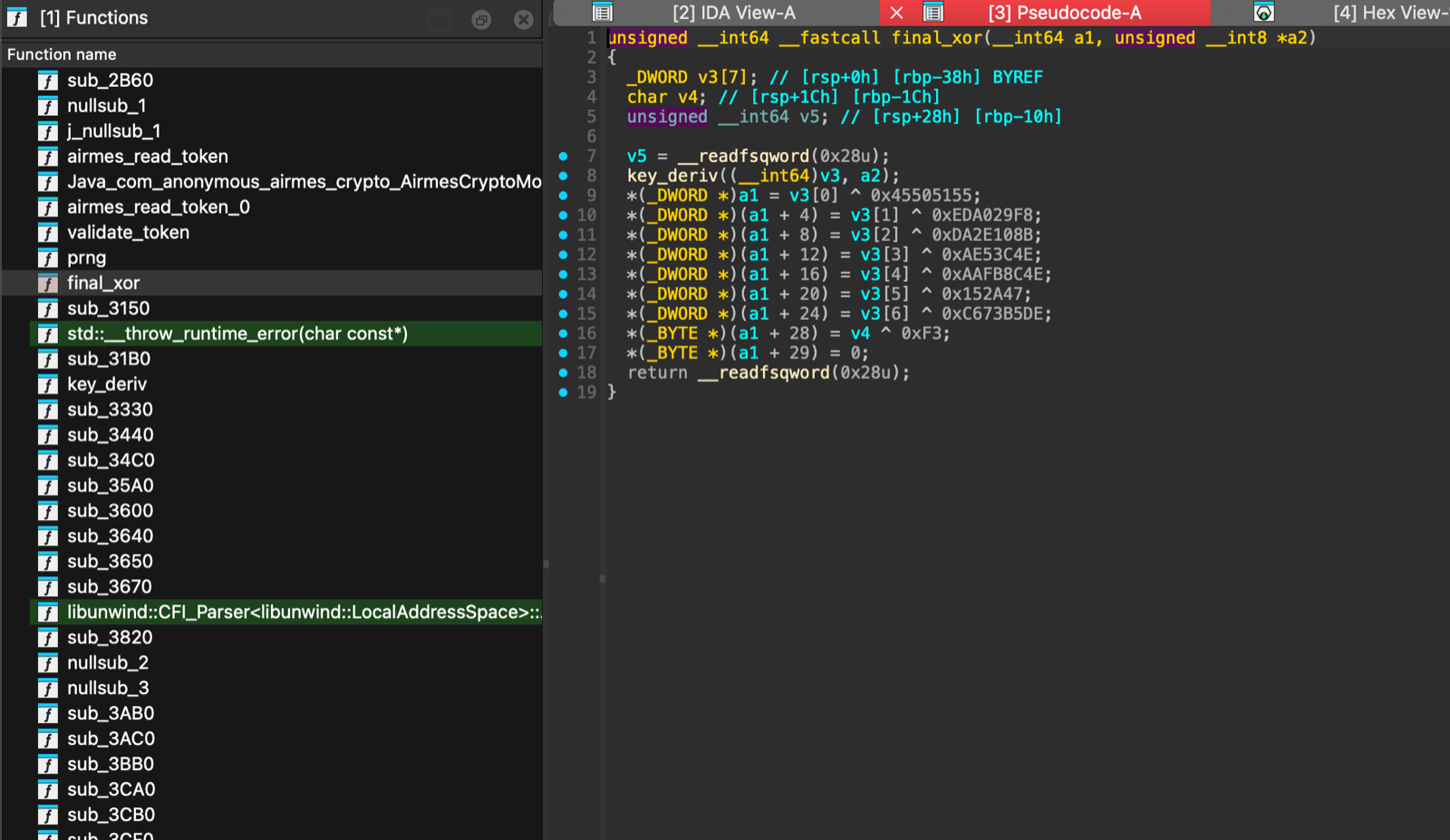
The IDA pseudocode for this function is clean and we can read the constants directly:
unsigned __int64 __fastcall sub_30A0(__int64 a1, unsigned __int8 *a2)
{
    _DWORD v3[7];
    sub_31D0(v3, a2);                       // key derivation -> keystream

    *(_DWORD *)a1       = v3[0] ^ 0x45505155;
    *(_DWORD *)(a1 + 4) = v3[1] ^ 0xEDA029F8;
    *(_DWORD *)(a1 + 8) = v3[2] ^ 0xDA2E108B;
    *(_DWORD *)(a1 + 12) = v3[3] ^ 0x0AE53C4E;
    *(_DWORD *)(a1 + 16) = v3[4] ^ 0xAAFB8C4E;
    *(_DWORD *)(a1 + 20) = v3[5] ^ 0x152A47;
    *(_DWORD *)(a1 + 24) = v3[6] ^ 0xC673B5DE;
    *(_BYTE *)(a1 + 28) = v4 ^ 0xF3;
    *(_BYTE *)(a1 + 29) = 0;               // null terminator
}
The 29-byte keystream is XORed against hardcoded constants to produce the flag string directly.
From IDA Pseudocode to C Solver
The key insight is understanding how to translate IDA's pseudocode into a working solver. Let's walk through the process.
Identifying the xorshift32 pattern
Inside sub_31D0, after the __ROL4__ mixing produces a 32-bit seed, IDA shows a loop that repeatedly applies three operations to a state variable:
v2 ^= (v2 << 13);
v2 ^= (v2 >> 17);
v2 ^= (v2 << 5);
This is the classic xorshift32 PRNG by George Marsaglia. Each iteration produces one pseudorandom 32-bit value, and the low byte (v2 & 0xFF) is stored as one byte of keystream. The loop runs 29 times to produce 29 keystream bytes.
The same xorshift32 pattern also appears earlier in sub_2EB0 (the PRNG generation step), where it runs 16 times after a djb2 hash of the token.
Translating the XOR constants
In sub_30A0, IDA gives us the XOR operation as _DWORD (32-bit) writes. For example:
*(_DWORD *)a1 = v3[0] ^ 0x45505155;
This means the first 4 bytes of the flag are computed as keystream[0..3] XOR 0x45505155. Since x86 is little-endian, the bytes are stored as [0x55, 0x51, 0x50, 0x45]. In the solver, we need to XOR byte-by-byte with the constant split into its individual bytes:
flag[i*4]   = ks[i*4]   ^ (c & 0xFF);         // low byte
flag[i*4+1] = ks[i*4+1] ^ ((c >> 8) & 0xFF);
flag[i*4+2] = ks[i*4+2] ^ ((c >> 16) & 0xFF);
flag[i*4+3] = ks[i*4+3] ^ ((c >> 24) & 0xFF); // high byte
The bruteforce shortcut
The entire chain (token -> djb2 -> xorshift32 -> ROL4 mixing -> xorshift32 -> XOR) ultimately depends on a single 32-bit value: the seed that enters the final xorshift32 loop. Since we know the flag starts with "INS{", we can compute what the first 4 keystream bytes must be, and bruteforce all 2^32 possible seeds. With early rejection (checking one byte at a time), this runs in seconds.
Reconstructed Algorithm
Looking at the full chain, everything collapses into a simple dependency:
token[8] -> djb2 -> xorshift32 x16 -> 16 bytes PRNG -> key_derivation (ROL4 mixing) -> seed2 (32-bit) -> xorshift32 x29 -> 29 bytes keystream -> XOR constants -> FLAG
The entire algorithm depends on a single 32-bit seed. We don't need provision.dat, the token, or even the intermediate steps. We can bruteforce all 2^32 possible seed values for seed2.
Known Constraint
The flag starts with "INS{" = [0x49, 0x4E, 0x53, 0x7B].
The first 4 keystream bytes must therefore satisfy:
keystream[0] = 0x49 ^ 0x55 = 0x1C
keystream[1] = 0x4E ^ 0x51 = 0x1F
keystream[2] = 0x53 ^ 0x50 = 0x03
keystream[3] = 0x7B ^ 0x45 = 0x3E
Each byte constraint eliminates ~255/256 of candidates. Four constraints reduce the search space to approximately 1 valid seed.
Solver
#include <stdio.h>
#include <stdint.h>

static const uint32_t xor_consts[] = {
    0x45505155, 0xeda029f8, 0xda2e108b, 0x0ae53c4e,
    0xaafb8c4e, 0x00152a47, 0xc673b5de
};

static inline uint32_t xorshift32(uint32_t x) {
    x ^= (x << 13); x ^= (x >> 17); x ^= (x << 5);
    return x;
}

int main() {
    uint8_t target[4] = {0x49^0x55, 0x4e^0x51, 0x53^0x50, 0x7b^0x45};
    for (uint64_t s = 0; s < 0x100000000ULL; s++) {
        uint32_t st = (uint32_t)s;
        st = xorshift32(st); if ((st&0xFF) != target[0]) continue;
        st = xorshift32(st); if ((st&0xFF) != target[1]) continue;
        st = xorshift32(st); if ((st&0xFF) != target[2]) continue;
        st = xorshift32(st); if ((st&0xFF) != target[3]) continue;

        uint8_t ks[29]; st = (uint32_t)s;
        for (int i = 0; i < 29; i++) { st = xorshift32(st); ks[i] = st & 0xFF; }

        uint8_t flag[30];
        for (int i = 0; i < 7; i++) {
            uint32_t c = xor_consts[i];
            flag[i*4]=ks[i*4]^(c&0xFF); flag[i*4+1]=ks[i*4+1]^((c>>8)&0xFF);
            flag[i*4+2]=ks[i*4+2]^((c>>16)&0xFF); flag[i*4+3]=ks[i*4+3]^((c>>24)&0xFF);
        }
        flag[28] = ks[28] ^ 0xf3; flag[29] = 0;
        if (flag[0]=='I' && flag[1]=='N' && flag[2]=='S' && flag[3]=='{' && flag[28]=='}')
            printf("FLAG: %s (seed=0x%08x)\n", flag, (uint32_t)s);
    }
}
$ cc -O3 -o solver solver.c && time ./solver
FLAG: INS{r3v_n4tiv3_cpp_w311_d0n3} (seed=0x060dce7d)
./solver  6.78s user 0.06s sys
Flag
INS{r3v_n4tiv3_cpp_w311_d0n3}